



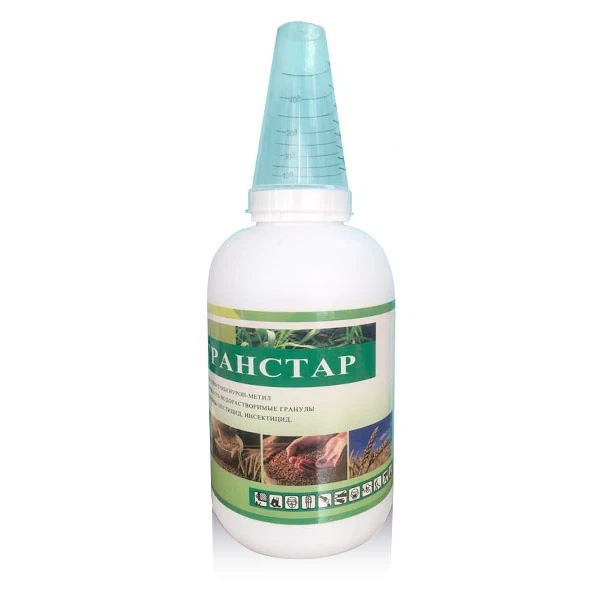
Tribenuron-methyl
Active Ingredient & Classification
Tribenuron-methyl (CAS No. 101200-48-0; molecular formula C₁₅H₁₇N₅O₆S) is a member of the sulfonylurea herbicide family. It is classified under HRAC Group 2 (WSSA Group B) as an acetolactate synthase (ALS) inhibitor.
Mode of Action — How It Works
Once applied, Tribenuron-methyl is absorbed by both leaves and roots of susceptible broad-leaf weeds. It is translocated into the meristematic tissue and inhibits the enzyme ALS, which is crucial for synthesis of branched‐chain amino acids (valine, leucine, isoleucine). This disruption halts cell division, leads to chlorosis (leaf yellowing), necrosis and eventual weed death, while cereal crops metabolise the molecule more rapidly and remain safe.
Key Benefits from the Chemistry
-
High potency: effective at very low use rates (for example 10–30 g/ha, depending on formulation) rather than hundreds of grams.
-
Selectivity: safe for target cereal crops, controlling broad-leaf weeds without harming the crop when applied correctly.
-
Lower environmental burden: less chemical load required, reduced bulk packaging and logistics cost.
|
Product Name |
Tribenuron Methyl |
|
CAS Number |
101200-48-0 |
|
Molecular Formula |
C15H17N5O6S |
|
Type |
Herbicide |
|
Brand Name |
Ageruo |
|
Formulations |
Tribenuron Methyl 75% Wp 、Tribenuron Methyl 75% Df 、Tribenuron methyl 75% WDG |
| Shelf life | 2 Years |
Formulation & Specifications
“75% WP” Explained
The “75% WP” indicates that the formulation contains approximately 75% (w/w) of the active ingredient Tribenuron-methyl in a Wettable Powder (WP) format. This high-content powder is designed for efficient transport, storage and handling.
WP (wettable powder) must be mixed with water for spray applications, and demands proper agitation and dust control in preparation.
Packaging & Storage
-
Standard packaging: e.g., 5 kg / 10 kg bags, or custom-size based on OEM requirements.
-
Storage conditions: store in a cool, dry place away from direct sunlight; keep container tightly closed. Typical shelf-life: 2 years under recommended conditions (check label for regional registrations).
-
At POMAIS we support customized packaging (small-pack, foil pouches, multi-language labels) and flexible MOQ for export customers.
Why This Formulation for Export Markets
For many international markets, high-content WP formulations like 75% WP offer logistics advantages: less volume/weight for given active content, familiar handling methods, and adaptable to local spray equipment. For distributors in Central Asia, Africa or Latin America seeking own-label solutions, the combination of high content + custom packaging is compelling.
Technical Specification Table
| Formulation | Active Content | Typical Packaging | Key Advantage |
|---|---|---|---|
| 75% WP | ~75% a.i. | 5 kg / 10 kg bag | High content, efficient logistics |
| (Optional) WG | ~75% a.i. | Granule format | Better water dispersibility, lower dust |
| (Optional WG/WDG versions available — contact POMAIS for details.) |
Efficacy & Application Scenarios
Target Crops
This herbicide is primarily formulated for cereal crops such as wheat (winter/spring), barley, oats, rye and triticale. These crops often face pressure from aggressive broad-leaf weeds that compete for nutrients and light.
Target Weeds / Weed Spectrum
Typical broad-leaf weeds controlled include species such as shepherd’s purse (Capsella bursa-pastoris), lamb’s-quarters (Chenopodium album), Artemisia spp., amaranths, pigweeds and other common broad-leafs. (Note: grass weeds, sedges or rushes are generally not the primary target of this product.)
Application Timing & Conditions
-
Best applied when the crop is at early leaf stages (e.g., 2–4 leaf stage) and weeds are small (cotyledon to 4-leaf).
-
Recommended dosage for 75% WP formulation: typically 10-15 g/ha (subject to registration, crop, weed pressure & local conditions).
-
Spray water volume: e.g., 200-400 L/ha to ensure uniform coverage of weed foliage.
-
Ideal environmental conditions: calm wind, moderate temperature, active weed growth, and no rain for at least 4 hours post-spray for rain-fastness.
-
Field results: symptoms may appear within ~5-10 days; full weed control achieved in 2-4 weeks depending on species and conditions.
Application Example Table
| Crop | Weed Stage | Dose (g/ha) | Spray Volume (L/ha) | Notes |
|---|---|---|---|---|
| Winter Wheat | Broad-leaf weeds 2-4 leaves | 12-15 g | 200-300 | Early post-emergence, calm wind |
| Spring Wheat | Chenopodium/Amaranthus 3-4 leaves | 10-13 g | 200-400 | Use flat-fan nozzles, drift control |
Usage Instructions & Technical Parameters
Dosage & Spray Parameters
-
Accurately weigh the required dose according to local registration and field conditions; mix thoroughly in the spray tank.
-
Agitate the tank before and during spray application to ensure uniform suspension of the WP formulation.
-
Use clean water; avoid heavy contamination of tank or nozzle.
-
After application, thoroughly rinse the tank and spray equipment to prevent carry-over to sensitive crops.
Compatibility & Tank-Mixing Tips
-
This product is compatible with many other herbicides and adjuvants provided the tank mix is authorized by local regulation and a small-scale test (jar test) is performed.
-
Always follow local label instructions for tank-mixing. Mis-mixing may reduce efficacy or increase crop risk.
Operational Precautions
-
Avoid application when weeds are under stress (e.g., drought, water-saturated, temperature extremes) as uptake may be reduced.
-
Avoid drift onto sensitive crops or plants; ensure spray overlaps are minimal and buffer zones maintained.
-
After treatment, restrict re-entry to treated fields according to label guidance; wear appropriate PPE.
-
Do not apply repeatedly in the same field season without rotating mode of action (see Resistance Management below).
Safety, Environmental & Regulatory Overview
Toxicity Profile
Tribenuron-methyl exhibits low acute toxicity to mammals, birds and beneficial insects when used according to label instructions.
Environmental Fate
Typical soil half-life is short under normal conditions (e.g., <15-20 days in neutral to alkaline pH soils), with low volatility and leaching potential.
Regulatory Status & Compliance
POMAIS products are manufactured in compliance with FAO / CIPAC quality standards and can be supplied with COA, MSDS, TDS and registration dossier support. The “75% WP” formulation is export-ready for many markets, subject to local registration and import permit requirements. Customers should verify target-country registration status before import.
Resistance Management & Use Limitations
Resistance Risk
Because Tribenuron-methyl acts via ALS inhibition (HRAC Group 2), weeds may develop resistance if the same mechanism is used repeatedly without rotation.
Best Practices to Delay Resistance
-
Rotate with herbicides of different modes of action (e.g., Group 4, 9, 14) in sequential seasons.
-
Avoid using the product alone year after year in the same field.
-
Use optimum rates, apply early when weeds are small, and include cultural/mechanical weed control as part of integrated weed management.
Use Limitations & Crop Rotation Notes
-
Grass weeds may be poorly controlled by this product; supplementary control may be required.
-
Some sensitive crops or subsequent crops may require rotation intervals; always refer to local label guidance.
-
Avoid application to crops under severe stress (extreme drought, frost, water-logging) as performance may be reduced.
Competitive Advantages & Product Positioning
Product Strengths
-
High-content formulation (75% a.i.) offers transport and storage efficiency for distributors.
-
The WP format is familiar to many regions, with proven field performance in cereals.
-
POMAIS offers full brand-build support: small-pack options, multilingual labels, custom formulation, and flexible MOQ that suit emerging markets.
-
Supportive logistics: export experience across Central Asia, Middle East, Africa, Latin America; fast lead-times and export documentation.
Market Differentiation vs Other Products
Compared with lower-content or older formulation herbicides, POMAIS Tribenuron-methyl 75% WP stands out for its combination of high potency, trusted active ingredient, and brand-customization support. Where markets demand both performance and brand flexibility (e.g., private-label, regional brands), this product offers unique value.
Target Audience & Go-to-Market Narrative
Our ideal customers include agro-chemical distributors, seed-crop companies, brand-owners, importers and governmental procurement agencies operating in wheat-barley regions. The value proposition: “secure a high-efficiency cereal herbicide, backed by full packaging/brand support and export logistics, with POMAIS as your manufacturing partner”.
Export & Localization Services
POMAIS offers:
-
Small-pack options: solid minimum from 5 g; liquid (if applicable) from 20 mL – enabling retail or pilot markets.
-
Multilingual label printing: English, Russian, Spanish, Arabic, etc. to match local regulatory needs.
-
Custom-brand OEM support: your logo, design, brand story on label.
-
Export documentation: COA, MSDS, registration dossier support, logistics and customs support – especially into Central Asia, Russia, Africa, Latin America.
-
Delivery: typical lead-time 20-30 days, reliability track record.
Contact us for MOQ, shipping terms, sample policy and brand-collaboration options.
FAQ
Q1: What types of weeds does Tribenuron-methyl 75% WP control?
A: It effectively controls many common broad-leaf weeds in cereal crops such as shepherd’s purse, lamb’s-quarters (Chenopodium album), Artemisia spp., amaranths, pigweeds. It is not optimized for grass weeds or sedges.
Q2: Can this product be used consecutively in the same field every year?
A: Not recommended. To delay resistance, rotate with herbicides of different mode of action and integrate cultural/mechanical weed control.
Q3: What is the ideal spray timing?
A: Apply when the cereal crop is in the early leaf stage (2-4 leaves) and target weeds are small (cotyledon to 4 leaf) under active growth.
Q4: Does POMAIS support branding and packaging customization?
A: Yes. We provide customized packaging (small pack to bulk), multilingual labels, private-label branding and flexible MOQ to support your market launch.
Q5: What is the shelf life and storage requirement?
A: Under proper storage (cool, dry, sealed container), shelf-life is typically 2 years. Avoid direct sunlight, high humidity and extreme heat.
Get Started / Contact Us
Ready to expand your cereal weed-control portfolio with POMAIS Tribenuron-methyl 75% WP? Contact us today for a sample, quotation, label design service or to discuss your market-specific needs. Let’s build your brand together.