



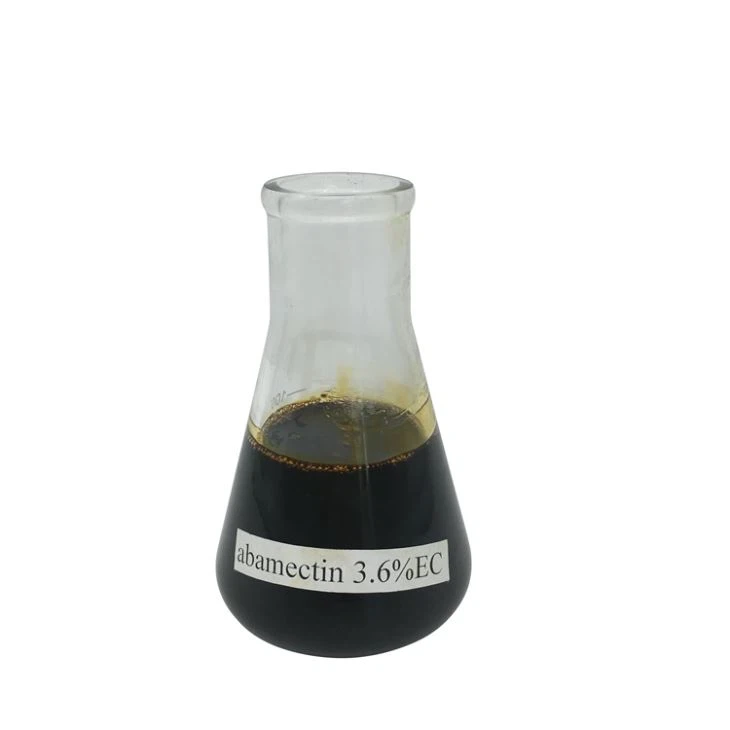
Abamectin 3.6% EC
Purpose-built for distributors who prefer EC (Emulsifiable Concentrate) with proven field acceptance and fast penetration. This page explains exactly what 3.6% EC means, how we control the assay, and what ranges/specs you can expect in procurement.
Other name: Avermectin
CAS No.: 71751-41-2
EINECS No.: 265-610-3
Molecular formula: C48H72O14
Shelf life: 2 years
Engineered for distributors and brand owners who need a proven EC system, clear concentration control, and export-ready documentation. This page focuses on what 3.6% means, the assay basis, appearance, stability window, and OEM configuration—so you can lock specs fast and move to samples and registration.
Product Snapshot
-
Type: Abamectin 3.6% EC (Emulsifiable Concentrate)
-
Label basis: configurable as % w/v (g/L) or % w/w (g/kg) to match the registration file
-
Appearance: clear light-yellow to amber liquid; low–moderate solvent odor (low-odor option available)
-
Key value: mainstream strength with broad market acceptance; efficient in logistics and familiar to field users
“3.6%” — Concentration & Assay Control
-
If labeled % w/v: nominal 36 g/L Abamectin at 20 °C (density-dependent).
-
If labeled % w/w: nominal 36 g/kg Abamectin.
-
Assay tolerance (typical): ±3–5% relative around label claim, released by HPLC per batch.
-
B1a/B1b profile: controlled by enterprise standard; COA reports total Abamectin and basis used.
-
Commercial note: 3.6% often hits the “sweet spot” between fewer drums than 1.8% and broader acceptance than 5% in many markets.
Technical Parameters (Procurement-Ready)
| Dimension | Target / Range | Notes |
|---|---|---|
| Active content (HPLC) | 3.6% label; ±3–5% rel. release window | Basis % w/v or % w/w per label/COA |
| Density (20 °C) | ~0.85–0.98 g/mL | Driven by solvent package |
| Viscosity (25 °C) | 10–80 mPa·s | Tuned for bottling & sprayers |
| Emulsion stability | Pass enterprise spec | Stable milky emulsion on dilution |
| Acidity / alkalinity | Within spec | Monitored to protect stability |
| Water (KF) | ≤ enterprise limit | Minimizes hydrolytic risk |
| Non-volatile matter | Within spec | Controls residue/film |
| Flash point | Per solvent choice (e.g., >23–60 °C) | Choose to meet HSE & transport class |
| Appearance | Clear, light-yellow → amber | No separation/foreign matter |
| Shelf life | 24 months sealed | As per label storage guidance |
Numeric limits finalized in the QA agreement and local standard alignment; COA shows the assay basis and method.
Formulation System & Ingredients
-
Solvent system: aromatic-free hydrocarbons / refined aliphatics, blended for flash point, odor, and solvency.
-
Emulsifier package: optimized non-ionic/anionics for hard-water robustness and pH drift tolerance.
-
Additives: UV stabilizer (light protection), antifoam, antioxidant; corrosion inhibitor where equipment or climate requires.
Stability & Packaging Integrity
-
Heat/cold stress: accelerated programs (e.g., 0–54 °C cycles); no phase separation, acceptable viscosity drift.
-
Light protection: UV stabilizer plus amber packaging and storage guidance.
-
Pack tests: drop/tilt and 24-hour inverted leak; cap seal verification; label adhesion/abrasion checks.
Appearance & Handling
-
In container: clear light-yellow to amber; homogeneous liquid.
-
Upon dilution: forms uniform milky emulsion; controlled foam.
-
Odor options: standard or low-odor (preferred in greenhouse/ornamental channels).
Packaging & Private Label Options
Liquids: 100 mL, 250 mL, 500 mL, 1 L bottles; 5 L, 10 L, 20 L jerrycans/drums.
Closures: child-resistant caps, induction seals, tamper-evident rings.
Labels: Arabic / Russian / Spanish / French / English and others; QR codes, serials, anti-counterfeit.
Lead time: typically 20–30 days after spec & artwork lock (subject to line capacity).
Docs: COA, MSDS; dossier support where applicable.
Market Fit & Buying Guidance
| Scenario | Why 3.6% EC Works | What to Specify |
|---|---|---|
| Middle East / Africa | Balance of strength and registration reach; good logistics efficiency | UV package; robust seals; Arabic/Fr labels |
| Row crops & mixed equipment fleets | Familiar EC handling; fast penetration and coverage | Standard solvent; jar-test advisory in label |
| Sensitivity to odor | EC still acceptable if low-odor solvent blend is used | Low-odor blend; flash-point target |
| Cold-weather transport | EC less freeze-sensitive than water-based systems | Winter storage/transport guidance on label |
Compatibility & Equipment Notes
-
Water quality: hardness and pH affect emulsions; we tune emulsifiers and recommend a jar test.
-
Tank mixes: follow registered label and local regulations; confirm physical compatibility before bulk.
-
Nozzles/filters: viscosity set for minimal clogging/drift; confirm filter mesh with your sprayer fleet.
Compliance & Stewardship
Abamectin is toxic to aquatic organisms and pollinators. Always follow the registered label, observe buffer zones, protect bees and aquatic environments, and implement IPM. Store and transport in original, sealed containers per label.
Quality Control & Certificates
-
Assay & identity: HPLC every batch with tight release window.
-
Physicals: viscosity, emulsion stability, foam control, appearance.
-
Stability records: heat/cold and light-protection data retained.
-
Certificates: COA/MSDS; dossier support on request.
OEM Configuration Menu (Choose Your Options)
-
Label basis: % w/v (g/L) or % w/w (g/kg)
-
Odor target: standard / low-odor
-
Flash-point class: select solvent to fit plant HSE and transport rules
-
UV & antifoam: enable/disable per market and equipment base
-
Packaging & language set: sizes, closures, Arabic/Russian/Spanish/French/English, anti-counterfeit
RFQ Checklist (Copy & Send)
-
Assay basis (w/v or w/w) and tolerance target
-
Solvent/odor preference and flash-point requirement
-
Stability goals (heat/cold/light) and QC items to show on COA
-
Packaging sizes, closures, label languages, anti-counterfeit
-
Destination market for dossier/label alignment
-
Samples required before bulk (bench, stability, pilot)
FAQ
Q1. Can you supply both w/v and w/w labels?
Yes. We align label and COA to the registration file; the COA states the basis and method (HPLC).
Q2. What’s your typical release tolerance around 3.6%?
±3–5% relative is standard unless a stricter window is contractually agreed.
Q3. Do you offer low-odor 3.6% EC?
Yes. We select refined solvent systems for reduced odor and target flash-point class.
Q4. Shelf life and storage?
Typically 24 months in sealed, original packs under label storage conditions (avoid extreme heat and direct sunlight).
Request your Abamectin 3.6% EC spec sheet and sample plan. Share assay basis, odor/flash-point target, pack sizes, and destination market. We will return a tailored specification, COA template, and a commercial offer aligned to your registration timeline.