



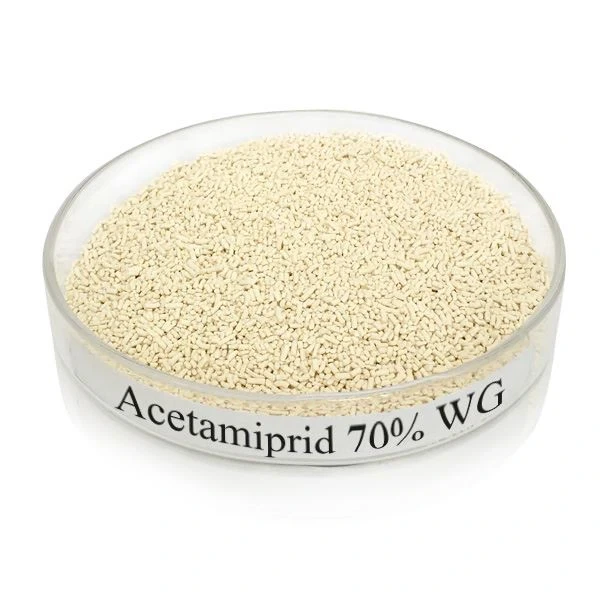
Acetamiprid 70% WG
This section focuses specifically on the formulation type and active-ingredient concentration for the 70% w/w specification of Acetamiprid in WG (Water-Dispersible Granule) format. For importers, brand owners and distributors targeting premium channels or large-scale operations, the 70% specification offers a differentiated solution. Understanding this high-load grade helps optimise your registration strategy, packaging choice, market positioning and supply-chain efficiency.
Acetamiprid pesticide has the advantages of contact killing, stomach poisoning and strong penetration. It has the advantages of quick insecticidal effect, low dosage, high activity, wide insecticidal spectrum, long lasting effect, and good environmental compatibility. It has special effects on pests that are resistant to organophosphorus, carbamates and pyrethroids.
|
Product Name |
Acetamiprid |
|
CAS Number |
135410-20-7 |
|
Molecular Formula |
C10H11ClN4 |
|
Type |
Insecticide |
|
Brand Name |
Ageruo |
|
Place of Origin |
Hebei , China |
|
Shelf life |
2 Years |
|
The mixed formulatiion products |
Acetamiprid 15% + Flonicamid 20% WDG Acetamiprid 3.5% + Lambda-cyhalothrin 1.5% ME Acetamiprid 1.5% + Abamectin 0.3% ME Acetamiprid 20% + Lambda-cyhalothrin 5% EC Acetamiprid 22.7% + Bifenthrin 27.3% WP |
|
Dosage Form |
Acetamiprid 20% SP 、 Acetamiprid 50% SP |
|
Acetamiprid 20% SL 、 Acetamiprid 30% SL |
|
|
Acetamiprid 70% WP 、 Acetamiprid 50% WP |
|
|
Acetamiprid 70% WG |
|
|
Acetamiprid 97% TC |
Acetamiprid Uses
It is suitable for controlling Hemiptera pests on fruit trees, vegetables and other crops.
Acetamiprid uses in agriculture is widely used for pest control on rice, vegetables, fruit trees, tea trees, cotton and other crops.
It can be used to control cotton aphids, wheat aphids, tobacco aphids, rice planthoppers, whitefly, Bemisia tabaci and various vegetable thrips.
Using granules for soil treatment can prevent and control underground pests.
Using Method
|
Formulation: Acetamiprid 70% WG |
|||
|
Crop |
Pest |
Dosage |
Usage method |
| Tobacco | Aphid | 23-30 g/ha |
Spray |
| Watermelon | Aphid | 30-60 g/ha |
Spray |
| Cotton | Aphid | 23-38 g/ha | Spray |
| Cucumber | Aphid | 30-38 g/ha | Spray |
| Cabbage | Aphid | 25.5-32 g/ha |
Spray |
| Tomato | Whiteflies | 30-45 g/ha |
Spray |
Note
1. Acetamiprid pesticide cannot be used together with alkaline pesticides, and acetamiprid is toxic to bees and silkworms.
2. The efficacy and temperature are positively correlated, and the high temperature has a good insecticidal effect.
3. Low toxicity to humans and animals, low lethality to natural enemies, low toxicity to fish, and little impact on bees.
High-Load Content – 70% w/w Active Ingredient
The label “70% WG” signifies a product containing 70% w/w of the active ingredient Acetamiprid in a Water-Dispersible Granule formulation. Compared to lower-concentration versions, such as 20% or 50%, this grade enables a greater mass of active compound per unit. The higher content delivers logistical and inventory benefits—especially relevant when servicing export markets, large distributors or professional users.
Although the granular WG format remains similar in basic physical behaviour—engineered granules that disperse in water—the technical demands are elevated with the 70% load. Manufacturers must guarantee consistent granule performance, rapid dispersion in water, and reliable field behaviour to meet professional user expectations.
Commercial Advantages of the 70% WG Specification
From a business-perspective, the 70% WG specification introduces several competitive advantages for your brand or distribution portfolio. First, by increasing the active content, fewer units may be required to deliver a given hectare treatment, improving per-unit logistics efficiency and reducing shipping burden.
Second, this specification supports a premium tier within your product range. You can position the 70% WG as a “professional / export grade” variant, differentiating from entry-level grades and enabling higher margin channels. For distributors serving larger farms or region-wide campaigns, this offers a value proposition of efficiency and performance.
Third, in markets where professional agronomy practices or export registration favour high-load formulations, the 70% WG meets these expectations directly. It aligns with channel needs for concentrated, logistics-efficient, high-performance insecticide grades.
Technical & Quality Considerations for the 70% WG Formulation
Producing a stable 70% WG formulation requires higher formulation and manufacturing discipline. With a larger proportion of active ingredient, issues such as granule flow-ability, moisture uptake, dispersion kinetics and batch uniformity become more pronounced.
Key technical checks include rapid and uniform dispersion of granules in water to form a consistent spray suspension, fine control of particle size and distribution, minimisation of dust and segregation, and robust packaging to prevent moisture ingress or clumping during storage and transport.
As a buyer, you should insist upon full batch Certificates of Analysis (COA) verifying the 70% content, stability testing (especially under hot/humid export conditions), and documented formulation and packaging protocols that support reliable field performance.
Packaging & Logistics Strategy for 70% WG
Packaging strategy aligned with the 70% specification should reflect the grade’s premium usage profile. Typical pack sizes might include larger bag formats (e.g., 500 g, 1 kg, 5 kg or bulk multi-kg sacks) tailored for large-scale users, repackers or export distributors.
Because the active-ingredient load per unit is higher, fewer packages may cover the same treated area compared to lower-load formats—thereby reducing pallet volume or shipping container count. However, this also places increased importance on packaging materials: high-barrier films or laminate bags, moisture control, and precise fill-weight control to safeguard the granular product through the supply chain.
For logistics planning, ensure that warehouse and transport conditions support the integrity of the WG granules: store in a cool, dry area, protect from direct sunlight, and maintain sealed packaging until deployment in the field.
Specification Comparison – 70% WG vs Lower-Load Grades
| Specification | Lower-Load Grades (e.g., 20% SP / 50% SP) | 70% WG |
|---|---|---|
| Active Ingredient Content | 20% w/w or 50% w/w | 70% w/w |
| Target User Segment | Retail, small farms, general distribution | Professional agronomy, large farms, export/distributor channels |
| Typical Packaging Options | 50 g–250 g, small packs | 500 g–1 kg+, bulk sacks possible |
| Brand Positioning | Entry or mid-tier product | Premium or pro-grade specification |
| Formulation Handling Requirements | Standard SP production controls | Enhanced QC, moisture/dust management, granule engineering |
Supplier Selection & Quality Assurances for 70% WG
When sourcing a 70% WG specification, your selection criteria should include: production experience with high-load granules, documented quality control systems, batch traceability, stability testing under export climate conditions and packaging performance testing (for moisture, caking, dust).
Ensure that your supplier can provide COA documents confirming 70% active content, technical data sheets (TDS), MSDS and previous export references in your target region. A supplier with proven capability in high-load WG formulations reduces risk and supports your brand’s credibility.
Call to Action
For full technical specifications, detailed pack-size options and quotation for the 70% WG variant of Acetamiprid, please contact our sales and technical team. Whether you are building a premium brand line or targeting large-scale distribution channels, the 70% WG format offers a high-performance, logistics-efficient solution. Align your registration documents, packaging strategy and market positioning with this advanced specification.
Note: Always ensure that product use complies with the local registered label and relevant regulations in the destination country.